You are browsing the archive for Critical Infrastructure.

DHS Says Aging Infrastructure Poses Significant Risk to U.S.

May 31, 2013 in Featured

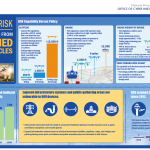
A recent version of the Department of Homeland Security’s National Risk Profile found that old and deteriorating infrastructure in the U.S. could pose significant risks to the nation and its economy. According to the report, insufficient funding of inspection and maintenance of critical infrastructure throughout the U.S. could create wide-ranging problems as the nation’s infrastructure continues to age. Along with pandemics and nuclear terrorism, a draft version of the DHS National Risk Profile for 2011 lists “aging infrastructure” as having a “potentially significant impact” on the nation’s critical infrastructure. The assessment states that “unusable, ineffectual, and deteriorating critical infrastructure, as well as the potential for exploitation of these vulnerabilities, increase risk . . . due to the inadvertent introduction of flaws, reduced inspection and maintenance workforce, and insufficient investment.” Moreover, this is not a limited threat, as the assessment states that the “entire United States is at risk from aging infrastructure that will eventually “affect all critical infrastructure sectors and ultimately reduce or erode their capacity and lifetimes in unexpected and unpredicted ways.”

(U//FOUO) DHS Cybersecurity Executive Order 13636 Critical Infrastructure Presentation

March 31, 2013 in Department of Homeland Security

A DHS presentation from March 11, 2013 regarding the implementation of Executive Order 13636 “Improving Critical Infrastructure Cybersecurity” authored by the Cyber-Dependent Infrastructure Identification Working Group (CDIIWG).

National Counterterrorism Center Says Urban Exploration Could “Aid Terrorists”

March 19, 2013 in Featured

The National Counterterrorism Center (NCTC) is warning law enforcement and first responders that urban exploration, an activity that involves trying to gain access to restricted or abandoned man-made structures, can provide useful information for terrorists conducting surveillance of a potential target. Also known as “building hacking”, urban exploration has been around in its modern form for decades, tracing some its more recent history to post-war exploration of the Parisian catacombs and members of MIT’s Tech Model Railroad Club Signals and Power Subcommittee, who organized explorations of steam tunnels and rooftops around campus in the late 1950s.

(U//FOUO) National Counterterrorism Center: Urban Exploration Offers Insight on Infrastructure Vulnerabilities

March 19, 2013 in National Counterterrorism Center

Urban Explorers (UE)—hobbyists who seek illicit access to transportation and industrial facilities in urban areas—frequently post photographs, video footage, and diagrams on line that could be used by terrorists to remotely identify and surveil potential targets. Advanced navigation and mapping technologies, including three dimensional modeling and geo-tagging, could aid terrorists in pinpointing locations in dense urban environments. Any suspicious UE activity should be reported to the nearest State and Major Area Fusion Center and to the local FBI Joint Terrorism Task Force.

(U//FOUO) FBI Awareness Message: Threats to Water Retention and Control Structures

November 11, 2012 in Federal Bureau of Investigation

Tens of thousands of dams, levees, navigation locks, industrial waste impoundments, and other water retention and control structures are located throughout the United States. Due to their iconic nature and potential impact on public safety, these structures present attractive targets for terrorist activity. Explosive attacks pose a significant threat, as evidenced by past plots against foreign infrastructure targets. Cyber intrusions present another concern and could be used to sabotage or control site operations. The FBI is interested in any information that could help mitigate threats to the security of dams or other water retention and control infrastructure.

(U//FOUO) FBI Awareness Message: Threats to Maritime Transportation

November 11, 2012 in Federal Bureau of Investigation

Maritime transportation infrastructure—to include watercraft, seaports, harbors, and waterways—is vital to the United States’ economy and national security. Maritime shipping accounts for ninety-nine percent of all US overseas trade. Additionally, passenger ships transport more than 140 million people to and from US ports each year. Countless vacationers enjoy maritime recreation on US lakes and beaches. All of these activities depend upon safe and open waterways, which the FBI defends from a variety of criminal and national security threats. A top concern is that past attacks on foreign passenger ferries and cargo liners could inspire similar action against US commercial vessels. Additional threats to maritime security include: contraband smuggling, human trafficking, piracy and crimes at sea, and cyber attacks against maritime information systems.

DHS Protective Security Advisor (PSA) Names and Locations March 2012

September 6, 2012 in Department of Homeland Security

A map of Department of Homeland Security protective security advisors (PSA) around the country from March 2012.

Unravelling TrapWire: The CIA-Connected Global Suspicious Activity Surveillance System

August 11, 2012 in Featured

A number of hacked emails from the private intelligence firm Stratfor have shed light on a global suspicious activity surveillance system called TrapWire, that is reportedly in use in locations around the world from the London Stock Exchange to the White House. The emails, which were released yesterday by WikiLeaks, provide information on the extent and operations of a system designed to correlate suspicious activity reports and other evidence that may indicate surveillance connected with a potential terrorist attack.

(U//FOUO) DHS-FBI Suspicious Activity Reporting Bulletin: Aviation Flyovers

August 7, 2012 in Department of Homeland Security, Federal Bureau of Investigation

Terrorists may use small aircraft flyovers to conduct preoperational activities such as reconnaissance or rehearsals for planned attacks. When suspicious flyovers occur, law enforcement and first responders should report the key attributes of the flight and the aircraft for timely identification (time of day, location and direction of flight, facility overflown, aircraft size, markings, color scheme, tail number, number of windows, placement of wings or rotor, number of engines, and weather) to the Federal Aviation Administration (FAA) through a local Air Traffic Control facility or office, a local Flight Standards District Office, or directly to the FAA’s Domestic Events Network at 202 493 5107, and the Transportation Security Administration. The FAA is often best able to distinguish between legitimate air traffic and suspicious flight operations that warrant further investigation.

DHS, FBI Warn Law Enforcement of Terrorists Asking Questions

June 21, 2012 in Featured

The Department of Homeland Security and Federal Bureau of Investigation are warning business owners and emergency personnel around the country to be on the look out for terrorists and criminals asking too many questions. In a bulletin from earlier this year, DHS and FBI warned that terrorists and criminals often exhibit the highly suspicious behavior of asking “pertinent, intrusive or probing questions” about security and operations at sensitive facilities. According to the document, terrorists or criminals “may attempt to identify critical infrastructure vulnerabilities by eliciting information pertaining to operational and security procedures from security personnel, facility employees or their associates” and that this type of questioning by individuals “with no apparent need for the information” can provide an “early warning of a potential attack.”

National Level Exercise 2012 Will Focus on Cyber Attacks Against Critical Infrastructure

April 10, 2012 in Featured

Rather than combating natural disasters or a nuclear detonation in a major U.S. city, this year’s National Level Exercise will focus on cyber threats to critical infrastructure and the “real world” implications for government and law enforcement of large-scale cyber attacks. National Level Exercise 2012 (NLE 2012) is scheduled to take place in June and will involve emergency response personnel from at least thirteen states, four countries, nearly every major governmental department as well as a number of private companies, non-governmental organizations, institutions of higher education and local fusion centers. The exercise will span four FEMA regions and will include scenarios affecting the National Capital Region.

(U//FOUO) DHS Infrastructure Protection Note: Evolving Threats to the Homeland

February 21, 2012 in Department of Homeland Security

The Office of Infrastructure Protection (IP) Homeland Infrastructure Threat and Risk Analysis Center (HITRAC) produces Infrastructure Protection Notes to address issues impacting the infrastructure protection community’s risk environment from terrorist threats and attacks, natural hazards, and other events. Based on the analysis within the DHS Office of Intelligence and Analysis product Evolution of the Terrorist Threat to the United States this IP Note outlines the evolution of terrorist threats and impacts to the Nation’s critical infrastructure.

DHS to Focus on Providing Intelligence to Local Governments, Private Sector to Counter Domestic Threats

January 21, 2012 in News

Nearly a decade after Congress created the Department of Homeland Security to prevent other 9/11-style terrorist attacks, a bipartisan group of experts says it is time for the agency to shift its focus from foreign enemies to working with local governments and the private sector so it can secure the border and critical infrastructure from homegrown threats. “The growth of our expectations of domestic security, and the evolution of threats away from traditional state actors toward non-state entities — drug cartels, organized crime, and terrorism are prominent examples — suggest that the DHS intelligence mission should be threat agnostic,” said a report by the Aspen Homeland Security Group, which is co-chaired by former Homeland Security Secretary Michael Chertoff.

(U//FOUO) Georgia Fusion Center: Suspicious Incident at Haralson County Water Treatment Facility

November 2, 2011 in Georgia, Intelligence Fusion Centers

The Georgia Information Sharing and Analysis Center (GISAC) is releasing this informational bulletin to enhance the situational awareness of law enforcement and security personnel with regard to a highly suspicious break-in incident that occurred on 24 October 2011 at the Haralson County Water Treatment Facility. During this incident, a subject broke in to the facility and was recorded (via security camera) taking pictures of the facility’s chlorination system, including the chlorine tank. In light of this highly suspicious incident, GISAC is urging facilities to be vigilant in their security measures and report any suspicious activity regarding water treatment facilities, or other critical infrastructure as soon as possible.

(U//FOUO) DHS Rising Copper Thefts Disrupting Homeland Infrastructure

August 10, 2011 in Department of Homeland Security

Reported copper thefts from critical infrastructure and key resource (CIKR) sectors in the United States rose at least 50 percent in 2010 compared to the previous year, largely driven by record-high prices for copper. Individuals and criminal organizations have engaged in copper thefts primarily for financial gain. We have seen no indication that terrorists are using copper thefts in the homeland as a tactic to damage or destroy CIKR facilities or to fund terrorist activity.

(U//FOUO) DHS Utility-Sector Employee Insider Threats Warning

July 26, 2011 in Department of Homeland Security

Insiders often possess detailed operational and system-security knowledge, as well as authorized physical and systems access to utilities. Insiders can be employees, contractors, service providers, or anyone with legitimate access to utility systems. They often are self-motivated, know system security measures, and raise no alarms due to their authorized systems access. With knowledge of and access to a utility’s network, malicious actors could seize control of utility systems or corrupt information sent to plant operators, causing damage to plant systems and equipment. Systems and networks used by utilities are potential targets for a variety of malicious cyber actors. Threat actors who target these systems may be intent on damaging equipment and facilities, disrupting services, stealing proprietary information, or other malicious activities. The greater the individual’s knowledge and authorized systems access, the greater risk the individual poses. Furthermore, any individual with access to a plant’s systems could unwittingly or inadvertently introduce malware into a system through portable media or by falling victim to socially engineered e-mails.

(U//FOUO) Massachusetts Commonwealth Fusion Center Hotels/Lodging Industry Warning

July 14, 2011 in Intelligence Fusion Centers, Massachusetts

As Al-Qa‘ida and other terrorist groups continue to seek innovative ways to conduct attacks and circumvent security procedures, there is concern that the holiday season provides attractive opportunities for terrorists to target the Homeland. This bulletin focuses on lodging facilities that serve large numbers of business and leisure travelers and provide venues for a variety of holiday events.

(U//LES) DHS Chemical Storage Facility Terrorist Indicators Report

May 17, 2011 in Department of Homeland Security

To consider terrorist threat indicators in relationship to chemical storage facilities, it is useful to understand the basic structure of the industry and what general types of facilities might be attractive targets for terrorist attack. Chemical storage facilities are attractive terrorist targets because they can contain toxic and hazardous materials, can create extensive casualties and property damage, and can be a source of materials for use in other attacks. Figure 1 shows some of the potential terrorist targeting objectives.

(U//LES) DHS Petroleum Pipeline Vulnerabilities and Terrorist Indicators Reports

May 17, 2011 in Department of Homeland Security

The United States (U.S.) has two types of pipelines that transport petroleum: those that carry crude oil and those that carry refined petroleum products, such as gasoline, diesel fuel, jet fuel, and home heating oil. Pipelines transport more than two-thirds of all crude oil and refined products in the U.S. Other transportation modes are water, which includes ocean tankers and barges and accounts for 28% of petroleum transportation; tanker trucks, which account for 3% of petroleum transportation; and railroads, which account for 2% of petroleum transportation. The U.S. has more than 200,000 miles of petroleum pipelines.

(U//LES) DHS Highway Tunnel Terrorist Indicators Report

May 17, 2011 in Department of Homeland Security

Highway tunnels are enclosed passageways for road vehicles to travel through or under an obstruction, such as a city, mountain, river, or harbor. Tunnels may have one or more “tubes,” and some are also equipped with rail lines for trains. Highway tunnels are generally classified with regard to their method of construction: bored, cut and cover, or submerged. Tunnels through hard rock formations are usually bored (i.e., drilled) and finished to facilitate vehicular traffic. Very large boring machines are often used to cut the tunnel tubes through the hard rock formation.

(U//LES) DHS Petroleum Refinery Characteristics and Common Vulnerabilities Report

May 15, 2011 in Department of Homeland Security

A refinery comprises upstream components, process units, downstream components, and product storage. There are four basic processes used in refineries to produce products. Distillation is used to separate hydrocarbons of similar boiling range into intermediate and final products. Chemical processes are used to change the structure of the hydrocarbons to give them different properties breaking them into smaller pieces or combining them into larger ones. Treating processes are used to remove impurities such as sulfur, and blending systems are used to combine intermediate products and additives into final products for sale.

(U//LES) DHS Chemical Facility Vulnerabilities and Terrorist Indicators Reports

May 13, 2011 in Department of Homeland Security

While hazardous and nonhazardous chemicals are stored and used in many industries, the focus of this report is specific to facilities that manufacture chemicals. A chemical manufacturing facility comprises upstream components, process units, downstream components, and product storage. The chemical manufacturing process can be further divided into the following five stages, each of which may contain one or more processing activities: (1) receipt of chemical ingredients, (2) temporarily staging or storing chemical ingredients awaiting use in production, (3) processing chemical ingredients into product, (4) temporarily staging or storing chemical products awaiting shipment, and (5) shipping chemical products.

(U//LES) DHS Fossil-Fuel Power Station Terrorist Indicators Report

May 12, 2011 in Department of Homeland Security

Steam power plants burn fossil fuel in the furnace of a steam boiler. Steam from the boiler expands through a steam turbine, which is connected to a drive shaft of an electric generator. The exhaust vapor expelled from the turbine condenses, and the liquid is pumped back to the boiler to repeat the cycle. Steam power plants are designed to use coal, natural gas, or oil. Before combustion gases can be exhausted to the atmosphere, they typically must be cleaned to reduce particulates, NOx, and SO2 to levels required by federal and state regulations.

(U//LES) DHS Subway Vulnerabilities and Terrorist Indicators Reports

May 12, 2011 in Department of Homeland Security

A subway system, as defined here, includes not only the portion of a rail rapid transit system that is underground, but also the other portions of the rail rapid transit system, even if they are not beneath the ground surface. Data for U.S. subways are typically collected under the heading of “heavy rail,” which is an electric railway with the capacity to transport a heavy volume of passenger traffic and characterized by exclusive rights-of-way, multi-car trains, high speed, rapid acceleration, sophisticated signaling, and high-platform loading. Heavy rail is also known as “subway,” “elevated (railway),” or “metropolitan railway (metro).” Subway systems are typically only one division of a transit agency. Bus, light rail, and commuter rail often operate as feeders to subway stations.

(U//LES) DHS Shopping Mall Characteristics and Common Vulnerabilities Report

May 9, 2011 in Department of Homeland Security

Shopping malls are potential targets for terrorist attacks because of the ability to inflict casualties, cause economic damage, and instill fear. Furthermore, they are “soft targets” in that they are serve the general public, and the presence of a significant number of American citizens is assured at certain times of the day. Due to the nature of their functions, these facilities usually lack perimeter or access controls. Due to their accessibility, soft targets are more vulnerable, and virtually impossible to defend against terrorist attacks. Damage or destruction of a large mall could inflict mass casualties, primarily on site; shut down or degrade its operation, thus having a significant impact on the economic well-being of a large area; have widespread psychological impact; and cause the release of hazardous materials.