Articles tagged with: Street gangs
Montana »
Texas »
Threats and Takedown Notices »
Public Intelligence has received a message from Captain Douglas R. Keyer, Jr. of the New York State Police requesting the removal of a fourteen-page “Gang Intelligence Newsletter” from November 2009 that is labeled “For Official Use Only” and “Law Enforcement Sensitive”. The document, which was published March 31, is evidently part of a series of monthly “Gang Intelligence Newsletters” that are issued to law enforcement personnel around the country. The newsletter contains brief profiles of the Aryan Brotherhood, National Socialist Movement, as well as some information on identifying gang tattoos and graffiti. This is also the second notice we have received that specifically requests us to identify the source of our information.
Intelligence Fusion Centers, New York »
U.S. Southern Command »
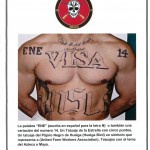
Maras emerged out of the conflicts during the 1970s & 80s in Central America. In the context of the wars and insurgencies in El Salvador, Guatemala, and Nicaragua, thousands of people, including youngmen fled North, many which had training on guns as well as armed combat techniques. In Los Angeles they encountered rejection by other Hispanic communities and found it difficult to find work and socialize; a percentage of these young men, especially those from El Salvador where part of the insurgency/ civil war back home and joined the 18th Street Gang from LA, which was started by Mexicans and expanded to other Hispanics, African- Americans, and Asians.
Intelligence Fusion Centers, New York »
This book is a compilation of various gang intelligence information from various sources including detective and police officer files, primarily confiscated from arrested and/or incarcerated individual gang notes and drawings. Additional material was obtained from other law enforcement agencies’ publications and presentations used for internal officer training, as well as from various other gang publications and internet sources. Six major New York City gangs are presented in this book: the Bloods, the Almighty Latin King and Queen Nation, the Netas, the Crips, Mara Salvatrucha (MS-13), and the Mexican Gangs. Sections within this book include the origin and history of the gang, its structure, rules and regulations, oaths and pledges, symbols and emblems, coded language and hand signals, clothing, tattoos and graffiti. It is our hope that an officer’s knowledge of gang characteristics will assist in combating gang-motivated crimes and reduce the propensity for violence towards the law enforcement community and innocent citizens.
Intelligence Fusion Centers, Virginia »
The Bloods street gang has become one of the most violent and notorious criminal organizations, spreading its influence in the U.S. from coast to coast. A traditionally African American gang, Bloods membership today includes Caucasians, Hispanics, and Asians. Blood members are involved in a variety of criminal activities including murder, assault, robbery, and narcotics distribution. Nationally, gang membership in the Bloods has been estimated between 15,000 and 20,000 members.1 Blood sets range from highly organized and structured groups similar to the Italian Mafia to loosely organized cliques with little discipline and loyalty. The Bloods have grown in popularity over the years thanks in part to the proliferation of music, movies, and television shows glorifying the “gangsta” lifestyle as well as social networking sites and the vast amount of information on the gang available on the Internet. Current intelligence gathered by the Virginia Fusion Center and other law enforcement agencies indicates the Bloods are a significant criminal threat to the Commonwealth and will continue to grow in numbers and operational scope.
Regional Information Sharing Systems »
Historically, Hispanic gangs north of the dividing line have claimed allegiance to the Nortenos and those to the south claimed allegiance to the Surenos. All California Hispanic criminal street gangs claim allegiance to the Nortenos or Surenos, with the exception of the Fresno Bulldogs. Whether it’s on the streets or in the correctional facilities, the Fresno Bulldogs function independently and do not align themselves with Nortenos or Surenos. The Fresno Bulldogs are a unique California based gang that has the power, strength and a large enough membership to stand on its own and remain free from the politics of the Nortenos and Surenos. All other Hispanic criminal street gangs are forced to choose a side whether they want to join in or not.
Texas »
This booklet is published by the Texas Department of Public Safety, Criminal Intelligence Service, with the cooperation of the Texas Department of Criminal Justice-Security Threat Group Management Office. It is being provided as a resource to assist law enforcement agencies and correctional staff in identifying possible members of Security Threat Groups (STGs) and is not to be disseminated outside your agency.
Local Law Enforcement »
ILP: Products
• Strategic Intelligence: Helps decision makers define a vision and hold managers accountable.
• Operational Intelligence: Gives managers adequate information to develop operational plans and adjust resources.
• Tactical Intelligence: Allows line personnel the ability to focus their efforts on solving problems and targeting the right people.
Federal Bureau of Investigation »
Several domestically based extremist organizations have demonstrated an interest in recruiting current and former gang members. No specific, credible intelligence indicates members of US-based street gangs are currently engaged in operational planning on behalf of terrorist organizations targeting the United States; however, former gang members have been arrested for terrorist plotting as recently as 2005. Terrorist recruitment patterns could potentially increase gang member involvement with terrorist groups.