Climatic Research Unit
- One of the leading scientific organizations researching and promoting an anthropogenic view of climate change
- Major component of United Nations Intergovernmental Panel on Climate Change
- Mainly funded by public and private grants, including grants from the European Union, NATO, and the U.S. Department of Energy
- Produces some of the most widely used data sets in the study of climate change
- May have manipulated data and used coercive tactics to purge contrary views from scientific literature
The Climatic Research Unit (CRU) is a research organization affiliated with the University of East Anglia in Norwich, England. The CRU is considered to be one of the leading institutions concerned with the research of anthropogenic climate change. The CRU is largely funded by public and private grants, having only three salaried positions with the University of East Anglia. In November 2009, a server operated by the CRU was hacked and a file containing more than 160MB of private emails, documents, and information was released to various internet sources.1
History of the CRU and Soft Money Funding
The Climatic Research Unit (CRU) was established in the School of Environmental Sciences (ENV) at the University of East Anglia (UEA) in Norwich in 1972 by Founding Director Professor Hubert H. Lamb.2 Professor Lamb’s “determination and vision” as the CRU describes it was against the generally prevailing view within the scientific establishment in the 1960s, that the climate for all practical purposes could be treated as constant. The weather changed from day-to-day, from week-to-week, and season-to-season. There was interannual variability, but over years (the perceived argument went) a constancy was reliably evident. According to the CRU’s own history:
Many climatologists will now say that CRU’s work in these early years played a major part in navigating the study of climate change out of an academic backwater and started to set the agenda for the major research effort in, and political preoccupation with, climate research since.3
The group’s history describes the early priorities of CRU as being “set against the backdrop of there having been little investigation before the 1960s of past climatic changes and variability, except by geologists and botanists, although there was an excess of theories”.4 The objective of CRU, therefore, was “to establish the past record of climate over as much of the world as possible, as far back in time as was feasible, and in enough detail to recognise and establish the basic processes, interactions, and evolutions in the Earth’s fluid envelopes and those involving the Earth’s crust and its vegetation cover”. The early efforts towards this objective were the interpretation of documentary historical records.5
Since its inception in 1972 until 1994, the only scientist who had a guaranteed salary from ENV/UEA funding was the Director. Every other research scientist relied on ‘soft money’ – grants and contracts – to continue his or her work. Since 1994, three of the senior staff are fully funded by ENV/UEA and two others have part of their salaries paid.6 Such longevity in a research center, dependent principally on soft money, in the UK university system is described by CRU as “unprecedented”. A small glimpse into this funding is provided by documents obtained following the November 2009 hacking incident. One document lists the accumulated grants of CRU Director Phil D. Jones and other researchers from 1991 onward. Despite the fact that Professor Jones is the CRU Director, and thus salaried by the University of East Anglia, these documents show more than £13 million in grants from a variety of government sources. Some of the funding parties include NATO, the European Union, the U.S. Department of Energy, and the British MET Office.
The CRU has also worked on contracts from a variety of commercial clients, including oil companies. The following description from the CRU’s official history provides a few brief examples:
A main thrust of the Unit’s research programme since the early 1980s has, therefore, been global warming: the human contribution, the future climate response, and possible impacts of future climate change, with an increasing emphasis on adaptation to these impacts. But this was not to the exclusion of other research, much of it of commercial relevance. A few examples follow. From the late 1970s through to the collapse of oil prices in the late 1980s, CRU received a series of contracts from BP to provide data and advice concerning their exploration operations in the Arctic marginal seas. Working closely with BP’s Cold Regions Group, CRU staff developed a set of detailed sea-ice atlases, covering estimates of data quality and climate variability as well as standard climatological means, and a series of reports on specific issues, such as navigation capabilities through the Canadian Archipelago. Assessment of the wind energy resource over the UK led to the development of predictive schemes to assess the potential power production at candidate wind turbine sites. Research on predicting canopy wetness as a vector for disease in cocoa plantations has been of special interest to Brazilian cocoa producers. Advice from CRU has been sought on far-future climate states in relation to the long-term safety of low- and intermediate-level radioactive waste storage sites. On shorter-term timescales, work on extreme events with implications for nuclear power station operation has been undertaken. Perhaps, not surprisingly, the insurance and re-insurance industries have been a regular sponsor of research with studies evaluating the risk of hurricane landfall on the Gulf and Atlantic coasts of the US, the impacts of severe storms in Europe and the characteristic of the typhoon risk over Japan. Former public utilities, such as the Central Electricity Generating Board (and latterly National Power) commissioned work from CRU on acid rain, wind energy, and surface ozone. Work has also been undertaken for Friends of the Earth and Greenpeace.7
CRU’s Involvement in Policy Guidance and Climate Impact
Since the 1980s, the CRU has been heavily involved with government efforts to study and address the threats presented by climate change. Much of this work has centered around research contributions to the Intergovernmental Panel on Climate Change (IPCC) and the United Nations Framework Convention on Climate (UNFCCC). Since the mid-1990s, CRU has co-ordinated 9 EU research projects and been a partner on 16 others within the 4th, 5th and 6th Framework Programmes. The official history of the CRU describes how they played a crucial role in shifting the IPCC from the conservative views stated in their earlier reports, such as the 1990 consensus view of the IPCC that carbon dioxide increases “could not yet be identified in the observed record”, to the body’s recent statement that “warming of the climate system is unequivocal”:
The UK Government became a strong supporter of climate research in the mid-1980s, following a meeting between Prime Minister Mrs Thatcher and a small number of climate researchers, which included Tom Wigley, the CRU director at the time. This and other meetings eventually led to the setting up of the Hadley Centre for Climate Prediction and Research, within the Met Office. At the same time, other governments were also taking notice and wanted more information. As this need was not being met by international scientific bodies and institutions at the time, they set up the Intergovernmental Panel on Climate Change (IPCC). This was under the United Nations Framework (later the UN Framework Convention on Climate Change, UNFCCC) and led to assessments being produced in 1990, 1995, 2001 and 2007. CRU staff have been heavily involved in all four assessments, probably more than anywhere else relative to the size of an institution (see IPCC AR4 Authors). The most recent IPCC assessment report (in 2007) has stated – “The warming of the climate system is unequivocal”.
In the late 1980s, CRU started to explore the pattern correlation “fingerprint” method of detection, a technique to assess how the observed pattern of climate change matches that which can be attributed to particular causes. This work culminated in 1995, when a team of researchers from American institutes and from CRU, using the computer simulations of climate change caused by increasing emissions of carbon dioxide, the most important greenhouse gas, and sulphate aerosols (developed by the Lawrence Livermore National Laboratory, USA), was able to detect the effects of these climate forcing factors in the climate observations. The results were in stark contrast to the consensus view expressed by IPCC in 1990, when it was stated that the effect of increased carbon dioxide concentrations could not yet be identified in the observed record. This work played a critical role in the conclusion reached by the 1995 assessment of the IPCC that “the balance of evidence suggests that there has been a discernible human influence on global climate”. Subsequent IPCC reports have strengthened these statements (in 2001: “there is new and stronger evidence that most of the warming observed over the last 50 years is attributable to human activities” and in 2007: “most of the observed increase in globally averaged temperatures since the mid-20th century is very likely due to the observed increase in anthropogenic greenhouse gas concentrations”) and led most governments, industries, multi-national companies and the majority of the public to accept that the climate is warming, and humans are part of the cause. Accepting the evidence is one thing, but not all governments appreciate the full scale of the problem yet.
In addition to CRU’s impact upon the global climate change resources produced by the IPCC, the CRU has also become a pioneering organization in the field of “climate impact”. This field is described in the CRU history as moving the agenda from “scientific determination of the global warming problem to how to solve the problem”.
This field has also led to much work in the climate impacts field, which has become gradually more extensive to support the discussion of mitigation and adaptation options. This moved the agenda from the scientific determination of the global warming problem to how to solve the problem. In the late 1990s, the UK Research Councils recognized the need for a centre to address these issues. CRU, ENV and other groups across the UK were successful with their bid, and the Tyndall Centre for Climate Change Research was born in 2000. The Tyndall Centre focuses on solutions to the problem of climate change, while CRU continues to work on all aspects of climate science. CRU and Tyndall work together on some projects, but their specific aims and agendas are different. The growing practical applicability of CRU work is nonetheless reflected in the increasing range of academic users, stakeholders, decision makers and professional bodies with which CRU is involved, as well as the range of impacts sectors covered. The latter include agriculture, water, health, energy and, most recently, the built environment. These aspects of CRU work in the UK are also facilitated by strong links with the UK Climate Impacts Programme (UKCIP) which was set up in 1997 – based at the University of Oxford.
Hacked Email and Questions of Academic Impropriety

A photo contained in the release of CRU hacked email and documents. The image was created on February 19, 2007.
In November 2009, a server utilized by the Climatic Research Unit at the University of East Anglia was hacked and more than 160MB of stolen documents and emails were disseminated to anonymously to various sources. The hack originated from an IP address in Turkey and was discovered when the hackers attempted to break into the server of realclimate.org, a site known for promoting anthropogenic global warming, and attempted to upload the files to their server. 8 The file titled “FOIA” contained a random sampling of more than 1,000 private emails, as well as more than 2,000 documents, commented source code, and programs for statistical modeling. A manipulated picture depicting climate change skeptics disparagingly is also included among the contents.
The private emails include a number of disturbing messages that included discussions of how to combat the arguments of climate change skeptics, unflattering comments about skeptics, how to keep scientists who have contrary views out of peer-review literature, and attempts to coerce other scientists into supporting initiatives relating to climate change. Direct quotes from these emails include the following statements:
- “The other paper by MM is just garbage – as you knew. De Freitas again. Pielke is also losing all credibility as well by replying to the mad Finn as well – frequently as I see it. I can’t see either of these papers being in the next IPCC report. Kevin and I will keep them out somehow – even if we have to redefine what the peer-review literature is !”9
- “Your approach of trying to gain scientific credibility for your personal views by asking people to endorse your letter is reprehensible. No scientist who wishes to maintain respect in the community should ever endorse any statement unless they have examined the issue fully themselves. You are asking people to prostitute themselves by doing just this! I fear that some will endorse your letter, in the mistaken belief that you are making a balanced and knowledgeable assessment of the science – when, in fact, you are presenting a flawed view that neither accords with IPCC nor with the bulk of the scientific and economic literature on the subject.”10
- “I really wish I could be more positive about the Kyrgyzstan material, but I swear I pulled every trick out of my sleeve trying to milk something out of that. It was pretty funny though – I told Malcolm what you said about my possibly being too Graybill-like in evaluating the response functions – he laughed and said that’s what he thought at first also. The data’s tempting but there’s too much variation even within stands. I don’t think it’d be productive to try and juggle the chronology statistics any more than I already have – they just are what they are (that does sound Graybillian). I think I’ll have to look for an option where I can let this little story go as it is”11
- I’ve just completed Mike’s Nature trick of adding in the real temps to each series for the last 20 years (ie from 1981 onwards) amd from 1961 for Keith’s to hide the decline.12
Significant Research Accomplishments
- In 1979, CRU hosted an international, interdisciplinary conference (Climate and History), a turning point for the future work on historical climatology and the influence of climate on human societies. This type of work still has an important place in CRU’s research portfolio to the present day, although it has broadened to include the development and analysis of early instrumental records and the extension of important climate indicators and datasets as far back in time as possible. A second international conference again focussing on historical climate variations and their links with societal change, but with a view to future changes and interactions, was held in 1998. An almost complete list of CRU publications is given here, including the volumes resulting from these two conferences.13
- Besides the global temperature data set, there has been much CRU effort devoted to the compilation of a comprehensive, quality-controlled precipitation data base. This, together with CRU’s high-resolution (0.5° by 0.5°) monthly datasets (for maximum and minimum temperature, precipitation, rainday counts, vapour pressure, cloudiness and wind speed) for all the world’s inhabited land areas, has provided many researchers, in the UK and overseas, with their basic data for a whole range of studies. It is likely that CRU ranks only behind NCEP/NCAR, ECMWF (ERA-40) and NCDC as the acknowledged primary data source by climate scientists around the world.14
- The area of CRU’s work that has probably had the largest international impact was started in 1978 and continues through to the present-day: the production of the world’s land-based, gridded (currently using 5° by 5° latitude/longitude boxes) temperature data set. This involved many person-years of painstaking data collection, checking and homogenization. In 1986, this analysis was extended to the marine sector (in co-operation with the Hadley Centre, Met Office from 1989), and so represented the first-ever synthesis of land and marine temperature data – i.e., the first truly global temperature record, demonstrating unequivocally that the globe has warmed by almost 0.8°C over the last 157 years. This work continues year-on-year to update and enhance the record and its publication is eagerly awaited around the world. The most recent innovation has been the development of a comprehensive set of error estimates at the grid-box and larger scales.15
Accumulated Grants of CRU Director Phil Jones
| CONTRACT | PI Full Name | GRANTS.TITLE | VALUE | LEDGER | STRT_DATE | END_DATE |
| DEPT OF ENVIRONMENT | Prof TML WIGLEY, Dr M HULME, Prof PD JONES | Climate change detection and GCM model validation | £179,484.00 | 24174 | 4/1/1991 | 3/31/1993 |
| DEPT OF ENVIRONMENT | Dr M HULME, Prof PD JONES | model variation | £101,914.00 | 24174 | 4/1/1993 | 3/31/1995 |
| NATO – NORTH ATLANTIC TREATY ORGANISATION | Prof PD JONES | Climatic variations and forcing mechanisms of the last 2000 years | £33,678.00 | 23766 | 3/21/1994 | 12/31/1995 |
| EUROPEAN UNION – EU / CEC | Prof PD JONES, Prof TML WIGLEY, Dr M HULME | Development and integration of a stochastic weather generator into a crop growth model for European agriculture | £59,446.00 | 23768 | 4/1/1994 | 12/31/1995 |
| EUROPEAN UNION – EU / CEC | Prof PD JONES, Dr KR BRIFFA | Dendroclimatic reconstruction from southern South American temperate forests | £39,833.00 | 48070 | 5/1/1994 | 7/31/1997 |
| NATIONAL RIVERS AUTHORITY | Prof PD JONES | Extended flow records at key locations in England and Wales – Phase 1 | £4,800.00 | 24178 | 6/1/1994 | 9/1/1994 |
| EUROPEAN UNION – EU / CEC | Prof PD JONES | Production of precipitation scenarios for impact assessments of climate change in Europe (POPSICLE) | £62,605.00 | 48100 | 7/1/1994 | 9/30/1996 |
| NERC | Prof TD DAVIES, Prof PD JONES | Climate variability and the “missing carbon” sink | £104,230.00 | 48150 | 1/1/1995 | 8/31/1998 |
| US DEPT OF ENERGY | Prof PD JONES, Prof TML WIGLEY | Detection of CO2 induced climate change (Suppl.) – cum. total £540,956, original start date 01/12/90 | £128,000.00 | 23760 | 3/1/1995 | 2/29/1996 |
| EUROPEAN UNION – EU / CEC | Prof PD JONES | Assessing the impact of future climatic change on the water resources and the hydrology of the Rio de la Plata Basin | £42,464.00 | 24162 | 5/15/1995 | 5/14/1999 |
| MASSACHUSETTS UNIV. | Prof PD JONES, Dr KR BRIFFA | The importance of paleoclimatic data for climate change detection studies | £20,953.00 | 24169 | 6/2/1995 | 8/31/1996 |
| NATIONAL RIVERS AUTHORITY | Prof PD JONES | Extended flow records at key locations in England and Wales – phase 2 | £19,780.00 | 24175 | 12/1/1995 | 7/31/1996 |
| NERC | Dr KR BRIFFA, Prof PD JONES | Exploring the potential for dendroclimatological analysis in Northern Ethiopia | £18,639.00 | 48180 | 1/1/1996 | 12/31/1996 |
| EUROPEAN UNION – EU / CEC | Prof TD DAVIES, Prof PD JONES | Annual to decadal variability in climate in Europe (ADVICE) | £209,843.00 | 4820 | 3/1/1996 | 5/31/1998 |
| US DEPT OF ENERGY | Prof PD JONES, Prof TML WIGLEY | Detection of greenhouse gas induced climate change (Suppl.) – cum. total £672,956, original start date 01/12/90 | £132,000.00 | 23760 | 3/1/1996 | 2/28/1997 |
| UNIV CORP ATMOS RES | Prof PD JONES, Dr D CONWAY | Downscaling of general circulation models (GCM) | £12,903.00 | 24190 | 10/14/1996 | 12/31/1996 |
| NERC | Prof PD JONES, Dr KR BRIFFA | Relationships between European climate and the North Atlantic oscillation: observations, models and paleodata | £24,859.00 | 24185 | 2/13/1997 | 11/12/1997 |
| US DEPT OF ENERGY | Prof PD JONES, Prof TML WIGLEY | Detection of greenhouse gas induced climate change (Suppl.) – cum. total £797,956, original start date 01/12/90 | £125,000.00 | 23760 | 3/1/1997 | 2/28/1998 |
| EUROPEAN UNION – EU / CEC | Prof PD JONES, Prof TD DAVIES, Ms CM GOODESS | Atmospheric Circulation Classification and Regional Downscaling (ACCORD) | £183,333.00 | 1076 | 12/1/1997 | 11/30/1999 |
| EUROPEAN UNION – EU / CEC | Prof PD JONES, Dr D CONWAY | WRINCLE: Water resources: influence of climate change in Europe | £71,333.00 | 1061 | 1/1/1998 | 12/31/2000 |
| EUROPEAN UNION – EU / CEC | Prof TD DAVIES, Prof PD JONES | Improved understanding of past climatic variability from early daily European Instrumental Sources (IMPROVE) | £33,333.00 | 1091 | 1/1/1998 | 12/31/1999 |
| US DEPT OF ENERGY | Prof PD JONES, Prof TML WIGLEY | Climate data analysis and models for the study of natural variability and anthropogenic change | £99,555.00 | 1220 | 5/1/1998 | 4/30/1999 |
| BRITISH SUGAR PLC/IACR – BROOM’S BARN | Prof TD DAVIES, Prof PD JONES | Sugar beet yield potential throughout northern and central Europe | £8,148.00 | 1228 | 8/1/1998 | 1/31/1999 |
| NERC | Dr KR BRIFFA, Prof PD JONES, Dr T OSBORN | Improving our understanding of natural climate variability by the combined use of observational, Palaeo and GCM climate data. | £92,383.00 | 1313 | 4/1/1999 | 6/30/2001 |
| US DEPT OF ENERGY | Prof PD JONES, Prof TML WIGLEY | Climate data analysis and models for the study of natural variability and anthropogenic change (Suppl.) | £102,752.00 | 1220 | 5/1/1999 | 4/30/2000 |
| UK WATER INDUSTRY RESEARCH LTD | Prof PD JONES | Effects of climatic change on the design and operation of CSOs | £5,000.00 | 1447 | 7/1/1999 | 9/30/1999 |
| US DEPT OF ENERGY | Prof PD JONES | Climate data analysis and models for the study of natural variability and anthropogenic change | £106,151.00 | 1220 | 5/1/2000 | 4/30/2001 |
| EUROPEAN UNION – EU / CEC | Prof PD JONES | CLIWOC: Climatological database for the world’s oceans 1750-1850 | £26,809.00 | 1858 | 12/1/2000 | 11/30/2003 |
| EUROPEAN UNION – EU / CEC | Prof PD JONES | SWURVE: Sustainable water uncertainty, risk and vulnerability in Europe | £123,600.00 | 1857 | 12/1/2000 | 2/29/2004 |
| EUROPEAN UNION – EU / CEC | Prof PD JONES, Dr KR BRIFFA | HOLSMEER: Late Holocene shallow marine environments of Europe | £99,492.00 | 1872 | 1/1/2001 | 6/30/2004 |
| NERC | Prof PD JONES, Dr JP PALUTIKOF, Dr T OSBORN | Accuracy of modelled extremes of temperature and climate change and its implications for the built environment in the UK | £39,255.00 | 2032 | 4/1/2001 | 8/31/2003 |
| US DEPT OF ENERGY | Prof PD JONES, Prof TML WIGLEY | Climate data and analysis from the study of natural variability and anthropogenic change | £212,500.00 | 1977 | 5/1/2001 | 4/30/2003 |
| NERC | Prof PD JONES | Investigation of the nature and courses of changes in Mediterranean rainfall and temperature extremes and the implications for future climate change | £34,660.00 | 1937 | 8/1/2001 | 2/28/2002 |
| HEFCE / JIF | Prof RK TURNER, Prof CG BENTHAM, Prof TD DAVIES, Prof T O’RIORDAN, Dr N PIDGEON, Prof PD JONES, Dr JP PALUTIKOF, Dr N ADGER | ICER: Institute for Connective Environmental Research | £6,608,541.00 | 2157 | 9/1/2001 | 8/31/2004 |
| MET OFFICE | Prof PD JONES | Development of radiosonde database and its use to study changing tropospheric lapse rates | £45,052.00 | 2196 | 12/1/2001 | 11/30/2002 |
| EUROPEAN UNION – EU / CEC | Ms CM GOODESS, Prof PD JONES | STARDEX: Statistical and regional dynamical downscaling of extremes for European Regions | £178,812.00 | 2209 | 2/1/2002 | 7/31/2005 |
| SCOTTISH OFFICE | Prof PD JONES, Dr JP PALUTIKOF | Update and re-examination of temperature indicies for Scotland and Northern Ireland | £14,164.00 | 2494 | 10/3/2002 | 5/2/2003 |
| CEC | Prof PD JONES | European and North Atlantic daily to multidecadal climate variability (EMULATE) | £134,978.00 | 2459 | 11/1/2002 | 2/28/2006 |
| EPSRC | Prof PD JONES, Dr JP PALUTIKOF, Ms CM GOODESS, Dr D VINER | Construction of climate scenarios for the integrating framework: built environment, transport and utilities | £105,178.00 | 2569 | 4/1/2003 | 3/31/2006 |
| EPSRC | Prof PD JONES, Ms CM GOODESS, Dr D VINER | CRANIUM: Climate change risk assessment: new impact and uncertainty methods | £69,125.00 | 2571 | 4/1/2003 | 5/31/2006 |
| NERC | Dr KR BRIFFA, Prof PD JONES, Dr T OSBORN, Dr S TETT | Quantitative applications of high resolution late Holocene proxy data sets: estimating climate sensitivity and thermohaline circulation influences | £226,981.00 | 2592 | 4/1/2003 | 3/31/2007 |
| MET OFFICE | Prof PD JONES | Investigating the role of surface vapour content in recent climate change – Studentship, Katherine Willett. | £13,870.00 | 12358 | 10/1/2003 | 9/30/2006 |
| ENVIRONMENT AGENCY | Prof PD JONES | River Flow Series from 1860′s to present | £9,000.00 | 12737 | 2/1/2004 | 3/31/2004 |
| EUROPEAN UNION – EU / CEC | Prof PD JONES | GAP | £105,499.00 | 12401 | 5/1/2004 | 4/30/2006 |
| US DEPT OF ENERGY | Prof PD JONES, Prof TML WIGLEY | Climate Data and Analysis – Study of Natural Variability and Anthropogenic Change. – Supp awarded £88,756 – 30.3.06 | £262,629.00 | 13192 | 5/1/2004 | 5/30/2006 |
| MET OFFICE | Prof PD JONES | CRU involvement in the development of an improved global historic surface temperature dataset | £14,492.00 | 3114 | 7/10/2004 | 3/31/2005 |
| EUROPEAN UNION – EU / CEC | Ms CM GOODESS, Dr JP PALUTIKOF, Prof PD JONES, ? ?? Unknown | ENSEMBLES | £426,895.00 | 12579 | 9/1/2004 | 8/31/2009 |
| SCOTTISH ENVIRONMENT PROTECTION AGENCY | Prof PD JONES | Scottish Temperature Indices | £730.00 | 3440 | 1/1/2005 | 4/30/2005 |
| ENVIRONMENT AGENCY | Prof PD JONES, Ms CM GOODESS | Environmental Effects of Agriculture & Land use: Weather Generator Tool | £26,516.00 | 13516 | 2/1/2005 | 3/31/2006 |
| ENVIRONMENT AGENCY | Prof PD JONES, Dr T OSBORN | The Impact of Climate Change on Severe Droughts.: Implications for Decision-Making (HO) | £52,177.00 | 13355 | 2/1/2005 | 3/31/2006 |
| CEC | Prof PD JONES, Dr JP PALUTIKOF | DeSurvey | £84,431.00 | 12270 | 3/11/2005 | 3/10/2010 |
| COUNCIL FOR THE CENTRAL LAB. OF THE RES. COUNCILS | Prof PD JONES | High resolution Climatic databases | £50,000.00 | 14080 | 1/1/2006 | 10/31/2006 |
| NERC | Dr M HULME, Prof H-J SCHELLNHUBER, Dr N ADGER, Dr K BROWN, Dr A HAXELTINE, Prof PD JONES, DR T LENTON, Dr A MINNS, Prof AR WATKINSON, ? ?? Unknown | Tyndall Phase 2 | £2,730,742.00 | 13320 | 4/1/2006 | 6/30/2009 |
- Ben Webster. Sceptics publish climate e-mails ‘stolen from East Anglia University’. Times of London. November 21, 2009 [↩]
- Climate Reserach Unit. History of the Climatic Research Unit. University of East Anglia [↩]
- Ibid. [↩]
- Ibid. [↩]
- Ibid. [↩]
- Ibid. [↩]
- Ibid. [↩]
- Andrew C. Revkin. Hacked E-Mail Is New Fodder for Climate Dispute. New York Times. November 20, 2009. [↩]
- mail/1089318616.txt [↩]
- mail/880476729.txt [↩]
- mail/0843161829.txt [↩]
- mail/0942777075.txt [↩]
- Climate Reserach Unit. History of the Climatic Research Unit. University of East Anglia [↩]
- Ibid. [↩]
- Ibid. [↩]
Related posts:
- Climatic Research Unit Emails: “Mike’s Nature trick” to “hide the decline”
- Climatic Research Unit Emails: “even if we have to redefine what the peer-review literature is!”
- Climatic Research Unit Emails: “You are asking people to prostitute themselves”
- Climatic Research Unit Strategic Review – Summary of External Input
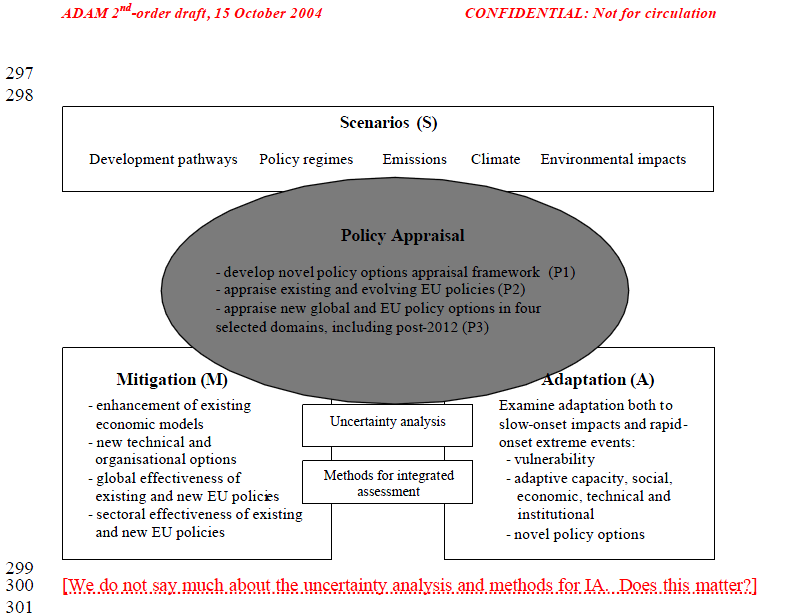
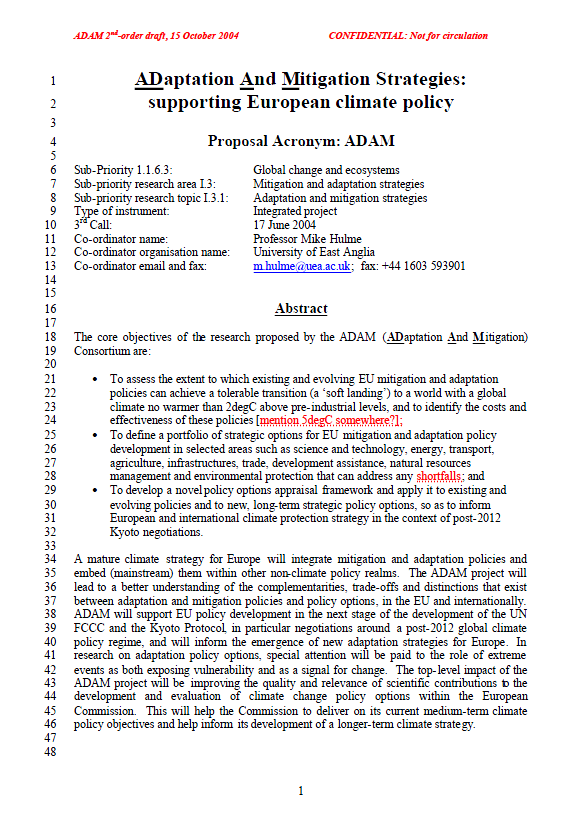
- Climatic Research Unit Documents: European climate policy adaptation and mitigation strategies


[...] (Nei mail rubati, ha scoperto che la CRU avrebbe ricevuto 200 mila dollari all’anno dal Dipartimento americano dell’energia. His got his underwear in a bunch for peanuts.) [...]
Leave your response!