Civilian Casualty Mitigation: Summary of Lessons, Observations and Tactics, Techniques and Procedures from Marine Expeditionary Brigade – Afghanistan (MEB-A) January – April 2010
- 29 pages
- For Official Use Only
- July 29, 2010

(U//FOUO) Fully understanding the imperative to balance employment of fires to defeat the enemy with the necessity to protect civilian lives, the Marine Corps has modified the training / education of ground commanders, aviators, forward air controllers (FACs), joint terminal attack controllers (JTACs), and others in the fire support approval chain. This incorporates lessons and guidance contained in the USJFCOM investigation into the Farah incident and the Commander, International Security Assistance Force (COMISAF) tactical directive issued in July 2009.
(U//FOUO) Marine Corps units and individuals preparing to deploy to Afghanistan are trained on theater specific directives and measures to prevent civilian casualties, to include rules of engagement (ROE), considerations for use of air to ground and indirect fires, and requirements for collateral damage estimation and battle damage assessment (BDA).
(U//FOUO) Training for forces deploying to Afghanistan is tailored for that threat and environment by monitoring events in theater, reviewing intelligence summaries, after action reports, e-mails, information provided by recently redeployed Marines, and MCCLL products. Instructor staff at Tactical Training and Exercise Control Group (TTECG) and Marine Aviation Weapons Training Squadron (MAWTS) 1 maintain situational awareness through periodic ‘lessons learned’ trips to Afghanistan and participation in video teleconferences with deployed forces.
(U//FOUO) Observations and best practices to mitigate potential for civilian casualties identified in this summary are consistent with counterinsurgency (COIN) doctrine relating to proportionality in use of force to achieve military objectives, discrimination of targets, and determination of acceptable risk to noncombatants. Understanding the long term effects on operations and mission success, avoidance of CIVCAS must be integrated into planning and operations. “There’s got to be a CIVCAS theme that goes through every aspect of planning and operations we do.” Col Michael Killion, G-3, MEB-A
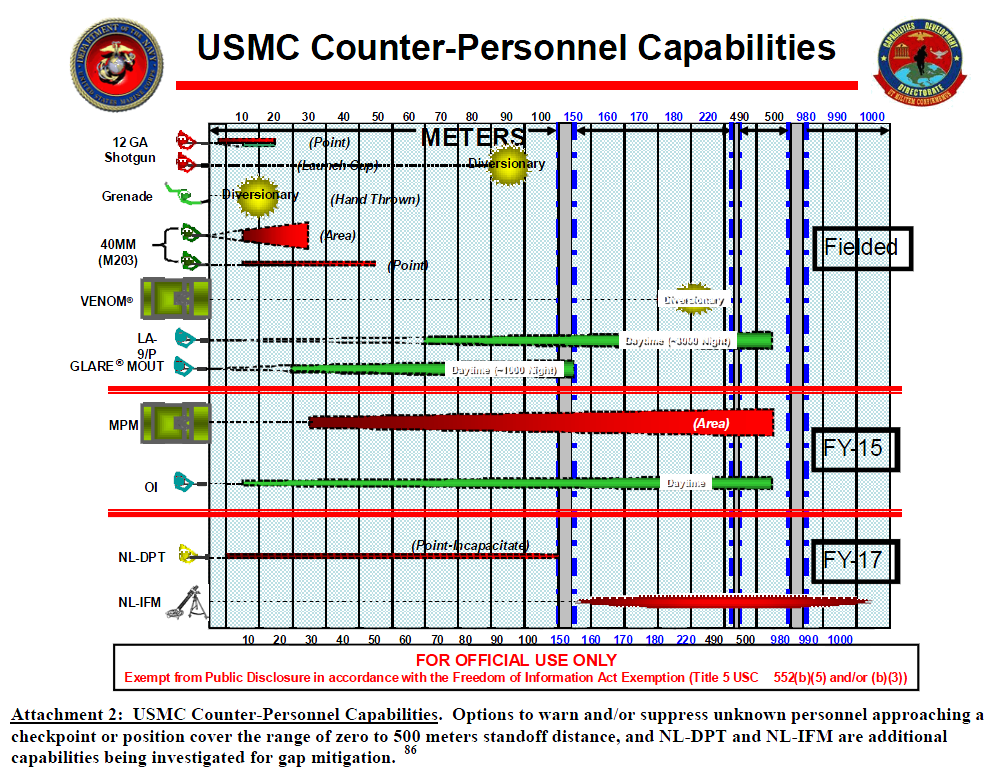
(U//FOUO) Throughout its ongoing procurement and fielding initiatives, the Marine Corps is investigating, procuring and fielding technologies that can aid in reduction of civilian casualties. These include non-lethal weapons systems currently employed in Afghanistan by I MEF (Fwd) and systems to be fielded over the next six years.
(U//FOUO) Capabilities/missions supported by currently fielded systems include vehicle check point (VCP), crowd control and entry control point (ECP) operations. Future systems will provide additional capabilities for these three missions and address functions of convoy security, conduct cordon, clear facilities, urban patrolling, establish and secure a perimeter, conduct search and detain personnel.
(U) Recommendations suggested by content of interviews include the following topics and associated implications for the doctrine, organization, training, material, leadership and education, personnel, and facilities (DOTMLPF) pillars.
…
Share this: