You are browsing the archive for Law Enforcement Sensitive.

(U//LES) FBI Sovereign Citizen Extremists Targeting Law Enforcement Creates Potential for Violent Traffic Stops

December 4, 2012 in Federal Bureau of Investigation

The FBI assesses with medium confidence, based on reliable source reporting and reports from other law enforcement agencies, some sovereign citizen extremistsb are making more specific plans to interfere with state and local law enforcement officers during traffic stops and, in some cases, intentionally initiating contact with law enforcement. The FBI assesses with medium confidence that a shift from reacting to law enforcement scrutiny1,2 to targeting police officers indicates an increased interest in harassing and intimidating police and may lead to potentially hostile confrontations.

(U//LES) FBI Pre-Deployment Checklist for Cyber Investigations

November 20, 2012 in Federal Bureau of Investigation

A document detailing investigative tools and materials utilized by the FBI when conducting cyber investigations. The document was distributed by the Oklahoma Bankers Association after being provided by a local branch of the FBI Cyber Division.

(U//LES) State and Local Anti-Terrorism Training (SLATT) Program: Terrorism Training for Law Enforcement

September 19, 2012 in Department of Justice

Eight presentations used in the State and Local Anti-Terrorism Training (SLATT) program for law enforcement, which is supported by grants from the Department of Justice’s Bureau of Justice Assistance.

(U//LES) FBI Going Dark: Law Enforcement Problems in Lawful Surveillance

September 14, 2012 in Federal Bureau of Investigation

‘Going Dark’ is a Law Enforcement (LE) initiative to address the gap between the legal authority and practical ability of LE to conduct lawfully-authorized electronic surveillance. Problems highlighted by the Going Dark initiative include LE’s difficulty in receiving information from some technology companies, and criminal’s use of advanced technologies and techniques that can complicate carrying out of lawfully-authorized court orders to conduct electronic surveillance.

(U//LES) FBI-NGIC Gang Criminal Activity Expanding Into Juvenile Prostitution

May 30, 2012 in Federal Bureau of Investigation

The National Gang Intelligence Center (NGIC) and the FBI’s Crimes Against Children Unit (CACU) assesses with medium confidence that gang activity is expanding towards juvenile prostitution primarily for its steady financial rewards and perceived low risk of law enforcement interaction. Historically, prison, street and outlaw motorcycle gangs profit from drug distribution and have recently become involved in non-traditional criminal activity such as mortgage fraud and identity theft. Some gangs appear to be diversifying their income by reducing or eliminating drug trafficking activities in favor of juvenile prostitution.

(U//LES) FBI Domestic Terrorism Operations Unit Introduction to Sovereign Citizens

May 18, 2012 in Federal Bureau of Investigation

Sovereign citizens believe the government is operating outside of its jurisdiction and generally do not recognize federal, state, or local laws, policies, or governmental regulations. They subscribe to a number of conspiracy theories, including a prevalent theory which states the United States Government (USG) became bankrupt and began using citizens as collateral in trade agreements with foreign governments. They believe secret bank accounts exist at the United States (US) Department of the Treasury. These accounts can be accessed using Internal Revenue Service (IRS), Universal Commercial Code (UCC), and fraudulent financial documents.

(U//LES) Louisiana Fusion Center Slide Fire Fully Automatic AR-15 Converter Bulletin

May 9, 2012 in Intelligence Fusion Centers, Louisiana

A new stock is being produced by Slide Solutions as a product named the SSAR-15. The product, a bump fire stock, is being sold over the internet and at local gun stores which easily converts special models of the AR to a fully automatic weapon. Information has been received that a Louisiana gun store in Lafayette has ten of them in stock and are selling them for around $380.00 a piece.

(U//LES) FBI Motorcycle Gang Trademarks Logo to Prevent Undercover Infiltration

April 17, 2012 in Federal Bureau of Investigation

As of 2 May 2011, the International Chapter of the Vagos Outlaw Motorcycle Gang (Vagos) trademarked their “cuts” – the patches which identify their OMG affiliation – in an effort to prevent law enforcement agencies from inserting undercover officers into their organization. The Vagos added the ® symbol to the bottom center of the large back patch as shown in photo 1. There are only about 20 of these new patches which are currently being worn by members. It is believed that the new patches will be given out to new members as they are vetted by the Vagos leadership. By doing this, the Vagos believe they will have exclusive rights to the Vagos patch and no one, including undercover officers, would be able to wear the patch without the consent of the International Vagos OMG leadership.

(U//LES) FBI International Expansion and Influence of US-Based Gangs

April 10, 2012 in Federal Bureau of Investigation

The purpose of this assessment is to explore the expansion and influence of US-based gangs abroad and their illicit operations and associations with foreign criminal organizations. For the purpose of this assessment, the term “gang” encompasses both street gangs and outlaw motorcycle gangs. In addition to FBI and open source reporting, the following law enforcement agencies from the United States, Canada, Central America, the Netherlands, and United Kingdom were surveyed to obtain data for the assessment.

(U//FOUO/LES) Baltimore Police Officer Safety Warning: Fighting Bandanas

April 7, 2012 in Maryland

Baltimore Police Department Officer Safety Warning on “Fighting Bandanas” from December 7, 2011.

(U//LES) California State Threat Assessment Center: How Male Gangs Leverage Female Supporters

April 2, 2012 in California

This bulletin provides information regarding the role females, who are not members, play within California gangs. Because females often avoid detection by law enforcement, to mitigate detection, male gangs leverage females to further their criminal activity.

(U//LES) National Gang Intelligence Center Street Gangs Involved in Tax Fraud Schemes

March 30, 2012 in Department of Justice

According to the Internal Revenue Service (IRS), incidents of tax return fraud have increased in recent years, and gang involvement in this criminal activity mirrors that trend. Gangs perpetrate tax return fraud by utilizing facilitators, such as employees of tax preparation companies. Prison gangs often employ females or other facilitators on the street to assist them, and communicate by legal mail to avoid law enforcement detection. While some of the fraud is committed using gang members’ information, gangs are also threatening and/or paying individuals a fixed amount for the personal identifying information and committing identity theft. The illicit revenues from these schemes are subsequently used to supplement traditional criminal activities and in overall furtherance of the gang.

(U//LES) FBI Mara Salvatrucha (MS-13) International Assessment

March 28, 2012 in Federal Bureau of Investigation

The purpose of this assessment is to provide an overview of the international activities of the MS-13 criminal organization. The report is the result of the analysis of arrest records, law enforcement reports, deportation records, interviews, and observations conducted by members of the MS-13 National Gang Task Force (NGTF) regarding documented MS-13 members in the United States; Chiapas, Mexico; El Salvador; and Honduras. Violent MS-13 members have crossed international boundaries and key members have documented links between the United States and the countries addressed in this assessment.

(U//LES) Central Florida Intelligence Exchange CopBlock.org Bulletin

March 26, 2012 in Florida, Intelligence Fusion Centers

Cop Block, based on the description on their Facebook page, is a “decentralized project supported by a diverse group of individuals united by their shared goals of police accountability, education of individual rights and the dissemination of effective tactics to utilize while filming police.” The project was founded in 2010 by an individual who started Cop Block due to his personal experiences with law enforcement when he was “a victim of the war on drugs, twice”.

(U//FOUO/LES) Washington D.C. Fusion Center: White Powder Letters Warning March 2012

March 15, 2012 in Intelligence Fusion Centers, Washington D.C.

Since 2007 an unknown subject has sent more than 360 letters containing a white, powder substance to various government officials, public schools and other locations. In May, 2011 20 letters were delivered to public schools in Washington, DC. Over the past two days similar letters have been received in Washington, DC; New York, New York; Dallas, Texas and Enfield, Connecticut.

(U//LES) FBI National Gang Threat Assessment 2011

February 28, 2012 in Federal Bureau of Investigation

Gang members armed with high-powered weapons and knowledge and expertise acquired from employment in law enforcement, corrections, or the military will likely pose an increasing nationwide threat, as they employ these tactics and weapons against law enforcement officials, rival gang members, and civilians. Associates, friends, and family members of gangs will continue to play a pivotal role in the infiltration and acquisition of sensitive information.

(U//FOUO/LES) Maryland Fusion Center Criminal Use of Police Scanner Apps and RadioReference.com

January 5, 2012 in Intelligence Fusion Centers, Maryland

During several recent contacts with criminal gang members, an identified Maryland law enforcement agency has heard their radio transmissions broadcast over a suspect’s smartphone. In one incident, officers pursuing a suspect on foot overheard the suspect listening to the pursuing officers’ radio transmission over a smartphone. The radio broadcasts of the agency’s primary secure law enforcement channel had an approximate delay of three seconds on the suspect’s smartphone. Further investigation revealed that the general public, as well as criminal gang members and associates, are utilizing the website www.radioreference.com to listen to law enforcement secure channels streaming via the Internet. Registration and access to the site is free, with advanced features available to premium subscribers. A customer is able to search radio frequencies throughout the country by state, metro area, city and/or zip code. The website advertises a search for trunked frequencies as well. The frequencies are obtained over the Internet and any cell phone that has web access can listen in.

(U//LES) National Drug Intelligence Center: Mexican Drug Cartels Operating Within U.S. Cities

October 31, 2011 in Department of Justice

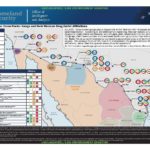
The National Drug Intelligence Center (NDIC) assesses with high confidence that in 2009, Mexican drug trafficking organizations (DTOs) were operating in the United States in at least 1,286 cities spanning all nine Organized Crime Drug Enforcement Task Force (OCDETF) regions, based on law enforcement reporting. Moreover, NDIC assesses with high confidence that Mexican DTOs in at least 143 of these U.S. cities were linked to a specific Mexican Cartel or DTO based in Mexico—the Sinaloa Cartel (at least 75 cities), the Gulf Cartel/Los Zetas (at least 37 cities), the Juárez Cartel (at least 33 cities), the Beltrán-Leyva DTO (at least 30 cities), La Familia Michoacán (at least 27 cities), or the Tijuana Cartel (at least 21 cities). NDIC assesses with high confidence that Mexican DTOs will further expand their drug trafficking operations in the United States in the near term, particularly in the New England, New York/New Jersey, Mid-Atlantic, and Florida/Caribbean Regions. NDIC also believes that Mexican DTOs will maintain the present high level of availability for heroin, marijuana, and methamphetamine because the conditions in Mexico and in the United States that enabled and motivated the DTOs to increase production and availability of those drugs have not significantly changed.

(U//LES) El Paso Intelligence Center Bulletins: Drug-Smuggling Ambulance, Cocaine in Tin Cans, Contaminated Pot

October 11, 2011 in Intelligence Fusion Centers, Texas

Three bulletins from the El Paso Intelligence Center on a drug-smuggling ambulance, cocaine hidden in tin cans and pot contaminated with Halon.

(U//LES) Los Angeles Joint Drug Intelligence Group Diverted Pharmaceuticals & Gang Distribution

October 10, 2011 in California

Los Angeles Joint Drug Intelligence Group Intelligence Bulletin on Diverted Pharmaceuticals & Gang Distribution from March 2010.

(U//FOUO/LES) Customs and Border Protection Bandidos Motorcycle Club Global Map

October 7, 2011 in Customs and Border Protection

Customs and Border Protection Bandidos Motorcycle Club global distribution map produced in May 2010.

DHS Bomb-Making Materials Awareness Program (BMAP) Law Enforcement and Private Sector User Guides

October 6, 2011 in Department of Homeland Security

Department of Homeland Ssecurity Bomb-Making Awareness Program (BMAP) Law Enforcement and Private Sector User Guides along with accompanying promotional posters from 2009.

(U//FOUO/LES) Customs and Border Protection $1.7 Million Marijuana School Bus Seizure

October 4, 2011 in Customs and Border Protection, Texas

U.S. Customs and Border Protection Laredo Sector Intelligence Unit seizure of $1,757,665 of marijuana hidden in a cloned school bus from October 2009.

(U//LES) California State Threat Assessment Center: Gangs Seek Training to Enhance Their Skills

September 7, 2011 in California, Intelligence Fusion Centers

This STAC information note is intended to enhance law enforcement community understanding of training venues observed to have been used by gang members and to provide insight into their reasoning for engagement in these observed activities.

(U//LES) Mississippi Analysis and Information Center Gang Threat Assessment 2010

September 6, 2011 in Intelligence Fusion Centers, Mississippi

The following Gang Threat Assessment, prepared by the Mississippi Analysis and Information Center (“MSAIC”), was produced to provide a general outlook of gang presence and criminal activity in the State of Mississippi. Data in this report was obtained from the Mississippi Department of Corrections (“MDOC”) and provides statistics, research and key findings from corrections data, law enforcement reports as well as academic and open source research. This assessment is a follow-up from the Interim Gang Threat Assessment issued by MSAIC in September of 2010. The assessment contains crimespecific and corrections statistics attributed to the four most prevalent gangs (“core” gangs) in the state: Gangster Disciples, Simon City Royals, Vice Lords and Latin Kings. From the four core groups they are attributed to the higher affiliations which are Folk Nation (Gangster Disciples and Simon City Royals) and People Nation (Vice Lords and Latin Kings). The assessment also includes brief descriptions of other gangs including MS-13, Aryan Brotherhood and Outlaw Motorcycle Gangs.